
.svg)
Volleyball AI Analysis Platforms: Comparisons
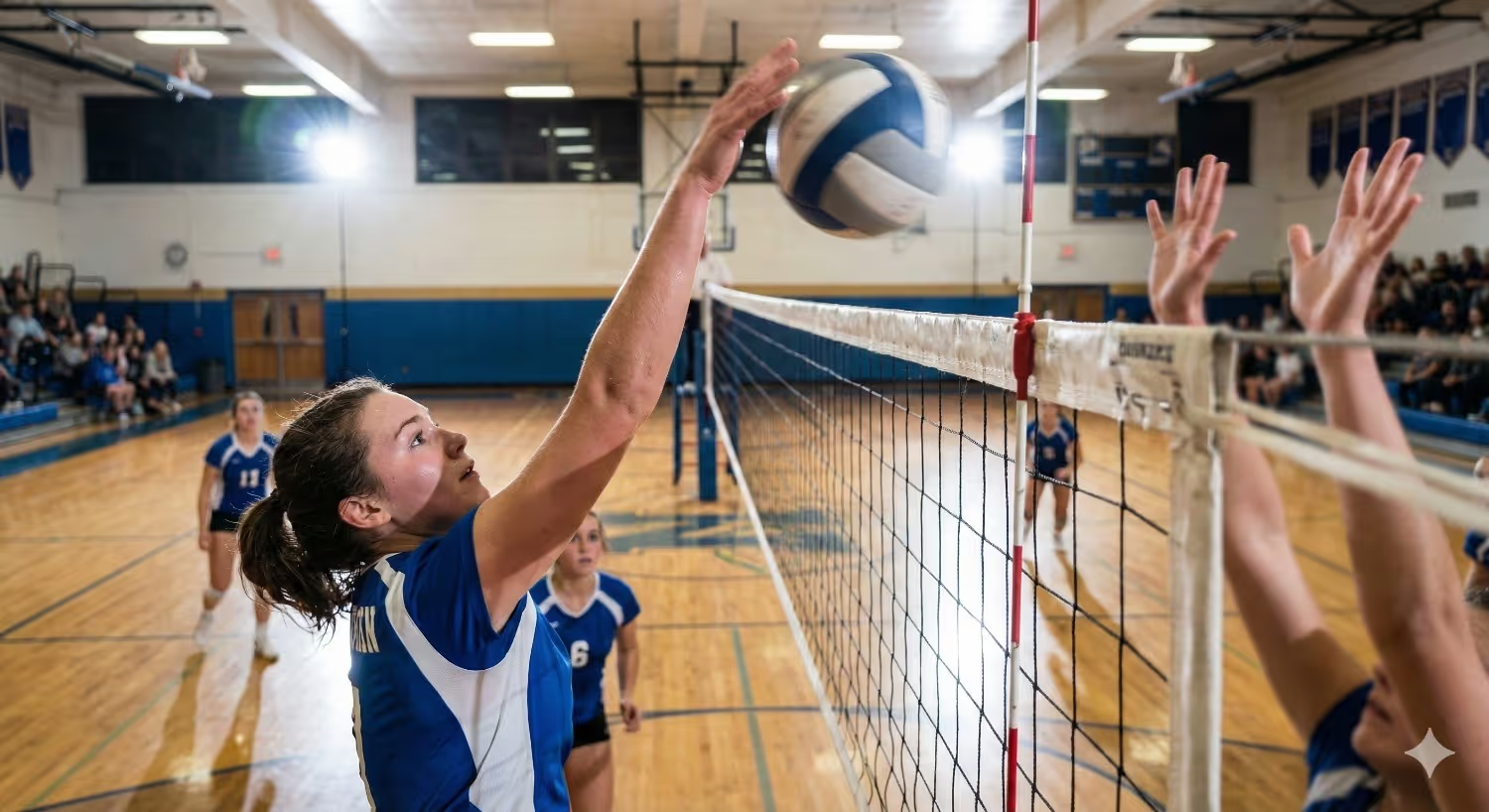
Volleyball has always been a sport of patterns. Serve receive shape determines what you can run. Setter location changes hitter options. A single rotation can turn a close set into a run. Coaches have always known this, the hard part is collecting enough clean information to act on it without turning film review into a second full time job.
That is why “AI analysis” has become the headline for volleyball video platforms. The promise is simple: upload video, get organized breakdowns, clips, and stats that you can actually use, without hours of manual tagging.
The reality is more nuanced. Most platforms are converging on similar outputs, but they differ dramatically in workflow, accessibility, and how well they fit youth and club environments. That is where SportsVisio has a clear advantage, because it is built around the real world constraints of clubs and varsity programs, limited staff, rotating volunteers, and athletes who want their clips on their phone.
What follows is a practical comparison of the main categories of volleyball analysis platforms, what “AI analysis” actually means in 2026, and how to pick the right approach for your program.
What “AI analysis” actually means in volleyball
When a vendor says “AI analysis,” they are usually combining some or all of the following capabilities.
- Rally segmentation: The system identifies when each rally starts and ends, removes dead time between points, and creates a rally level timeline.
- Action recognition: The system labels volleyball actions such as serves, passes, sets, attacks, blocks, and digs, sometimes with more detail like attack type or outcome.
- Player attribution: The system associates touches to specific athletes. This is easy when rosters are configured correctly and video angles are stable, and it is harder when numbers are not visible or when the camera is moving.
- Stats generation:The system turns detected events into box score style stats and efficiency metrics. SportsVisio positions its volleyball product around delivering standard volleyball statistics and highlight reels for players.
- Clip creation and sharing: The system makes it easy to find, filter, and share the moments that matter, whether that is for coaching, recruiting, or parent engagement. Hudl’s messaging for volleyball AI breakdowns emphasizes uploading film and getting insights with no coding or tagging.

The important distinction is that “accuracy” is not the only goal. For club and youth volleyball programs, AI analysis platforms differ less in accuracy than in workflow and accessibility, meaning the best platform is often the one that reliably fits how your team actually operates.
The platforms you will see most often
Most volleyball programs end up comparing across three buckets.
- AI first platforms: These are built around automated breakdowns, tags, and clips, with minimal manual coding.
- Pro scouting platforms: These are built around detailed manual coding, deep customization, and high control, often used at high levels.
- Video platforms with analysis add-ons: These may include cameras, streaming, or general video tools, and then add volleyball analysis features.
SportsVisio sits in the AI first bucket with a club friendly, player friendly product approach, and it is especially strong when you want to deliver value to coaches and athletes quickly, without needing a dedicated analyst.
Feature comparison table
Below is a high level comparison of how the major options tend to differ in practice. Capabilities can vary by package and region, so treat this as directional, then validate against your needs.
SportsVisio (AI stats, highlights, app delivery)
Best for: School, club and youth programs that want stats plus highlights without staffing overhead.
Typical setup effort: Low, capture and upload video, configure team context.
Coach workflow fit: Strong for time constrained coaches, review, share, develop athletes.
Player and parent accessibility: Very strong, consumer friendly delivery is a core product behavior.
What you give up: Less emphasis on bespoke pro scouting workflows than manual coding tools.
Hudl Assist and Hudl ecosystem (includes volleyball AI breakdown messaging)
Best for: Programs already standardizing on Hudl video workflows.
Typical setup effort: Medium, depends on your Hudl setup and product mix.
Coach workflow fit: Strong when your staff is trained on Hudl processes.
Player and parent accessibility: Good, varies by subscription and sharing settings.
What you give up: Can become complex across products, availability differs by level.
DataVolley and DataVideo style pro scouting tools
Best for: Varsity and higher levels that want deep customization and full control.
Typical setup effort: High, training and consistent coding standards required.
Coach workflow fit: Excellent if you have skilled operators and consistent processes.
Player and parent accessibility: More coach analyst oriented, player sharing depends on your workflow.
What you give up: Time cost, staffing requirement, steeper learning curve.
A few notes worth calling out.
Hudl’s volleyball breakdown availability has varied by segment, and it has publicly described different availability for club, college, and high school, including “coming in 2026” language for some high school breakdowns.
DataVolley emphasizes deep analysis capability and the ability to create and manage analysis without restriction, which is powerful, but it implies skilled usage and heavier workflows.
Where SportsVisio wins for school and youth volleyball
Most comparison pages focus on features. Coaches care about outcomes. SportsVisio is strong because it removes friction across the entire path from video to usable coaching and player value.
1. Workflow that matches club reality
Club volleyball does not run like a college program. You may have multiple teams, multiple gyms, rotating parents, and inconsistent capture setups. The “best” platform is the one your program can execute every weekend.
SportsVisio is built around a straightforward loop: capture video, upload it, and then receive stats and highlight content back in an app experience designed for athletes and families, not just analysts. SportsVisio’s own FAQ language sets expectation around post game processing, often within 24 hours, which matches how most clubs actually review and share content.
2. Player value is not an afterthought
In youth and club volleyball, athletes want clips for development, recruiting, and sharing, and families want to see proof of progress. SportsVisio explicitly positions highlight reels for all players as a core part of the product.
That matters because adoption follows value. If players are using the platform, coaches get leverage. They can assign review, reinforce concepts, and build a shared language around performance without needing every athlete to sit in a film room.
3. You get both stats and video context
Volleyball coaching rarely happens with stats alone. You want to see the sequence, not just the outcome. SportsVisio’s model is built around linking stats and highlights so a coach can move from a number to the play quickly, then reinforce it with athletes in a way that fits modern attention spans.
This is also where AI analysis becomes more than novelty. Rally segmentation and touch labeling are only useful if the product makes it easy to turn those outputs into coaching actions.
What that looks like in a real season
Trinity Christian School head coach Lindsay Foley describes the loop working exactly as intended:
“We played a team early in the season and lost pretty badly. After reviewing the stats, we realized their strongest server was targeting our weaker receivers. For the next game, we adjusted the rotation — and we won!”
That is the whole argument in one anecdote. The stats were not the point, the rotation change was. Read the full story: From Good to Great: Coach Lindsay’s Volleyball Success with SportsVisio.
Where Hudl and Balltime are strong
A fair comparison should acknowledge the strengths of the dominant vendors.
Hudl has an extensive ecosystem, and its volleyball messaging emphasizes removing the need for manual coding and tagging, then surfacing insights and key moments after upload. It also has deep volleyball roots through VolleyMetrics for higher level workflows, and it is often a default choice when an athletic department standardizes on one vendor.
Balltime has been a clear leader in athlete friendly AI volleyball breakdown presentation, and it describes removing dead time, breaking down every rally, and producing action and player based clips automatically. If your primary need is a fast, searchable library of rallies and touches, it is a strong benchmark.
The key point is that both of these can be good options, but many clubs find the operational center of gravity matters more than any single feature.
Club versus varsity use case clarity
This is where most buyers get stuck, because the same words, analysis, tagging, stats, can mean very different requirements.
Club and youth programs
Your constraints tend to look like this.
You have limited staff time.
You need athletes and parents to self serve.
You need reliable capture and upload, even with volunteers.
You want value within a day or two, because the next match is coming.
For this environment, an AI first platform that prioritizes accessibility often wins, and SportsVisio is positioned directly for that reality, with a product built to deliver stats and highlights back to a broad audience quickly.
Varsity and higher levels
Your constraints tend to look like this.
You have more stable staffing, sometimes a manager or analyst.
You want opponent scouting, rotation tendencies, and custom breakdown views.
You may code practices, not just matches.
You value full control and deep customization.
In this environment, pro scouting tools like DataVolley can be a great fit, because they are designed to let skilled users create and query detailed analysis without restriction. Hudl’s higher end volleyball workflows can also fit well when a program commits to the ecosystem and training.
The good news is that the gap between these worlds is shrinking, and SportsVisio is a strong option for varsity teams that want modern, low-overhead analysis and athlete engagement, especially when the program does not want to rely on a single expert operator.
How to choose, the decision questions that actually matter
Instead of asking “which platform has the most features,” ask these questions.
- Who is responsible for making this happen every week? If the answer is a coach or a rotating parent, prioritize low-friction workflows and athlete-friendly delivery.
- What is your primary output? If you want player development and recruiting clips, prioritize highlight accessibility and fast search. If you want opponent scouting with custom filters, prioritize pro analysis depth.
- How do you want athletes to engage? If you want athletes opening an app and reviewing their plays, choose a platform that treats players as first class users, not just recipients of a coach export.
- How fast do you need turnaround? If you plan to use insights before the next practice, post game delivery timelines matter more than theoretical maximum accuracy, and SportsVisio’s positioning around getting results back quickly fits common club cadence.
If you want the practical mechanics rather than the platform comparison, see how to track volleyball stats for school and club teams.
Bottom line
Most volleyball AI analysis platforms are converging on a similar idea: take match video, turn it into searchable rallies, touches, and insights and accurate stats, and then make it easier to coach and develop athletes.
The real difference is execution inside your program’s workflow.
If you are a club or youth program that wants a platform athletes will actually use, and you want stats plus highlights without building an analytics staff, SportsVisio is a top choice, because it is built around accessibility, fast post-game value, and player-focused delivery.
If you are a high-resource varsity or collegiate environment with trained analysts, and you need maximum customization, pro scouting tools, then the deeper ecosystem products can be a fit.
A useful rule is this. Choose the platform your program can run consistently. Consistency is what turns AI analysis from a cool demo into a competitive advantage.
Related Stories
Book a Demo and Get a Free Trial
Set up time to speak with our team and see our product in action.