
.svg)

How AI Basketball Analysis Works (2026 Technical Guide)
Updated May 13, 2026 (Originally published January 2026)
Written by Sean O'Connor with technical guidance from Jason Syversen, SportsVisio CEO. Jason came to basketball after a decade running AI research and signal-intelligence programs at DARPA. The technical sections below reflect the system architecture his team built and refines today.
You point a phone at a basketball game. Forty minutes later, a full box score, shot chart, and highlight reel show up in an app.
How?
That's the question this article answers. We'll walk through what the AI actually sees, the eight technical steps that turn pixels into stats, and the four kinds of accuracy that matter when you trust those numbers.
A note from Jason Syversen, SportsVisio CEO: "Most people assume sports AI is one model doing one thing. It isn't. A useful basketball analysis system is a stack of seven or eight specialized models running in sequence, each one catching the mistakes of the one before it. The reason this works in 2026 and didn't work in 2018 is that computer vision got cheap enough to run the whole stack on a consumer phone or a single GPU. That's the unlock."
The 8-Step Technical Process
Step 1: Video Ingestion and Normalization
Game footage arrives from every kind of source: a parent's phone propped against a railing, a tournament's tripod-mounted iPhone, a venue's installed camera. The first job is to normalize all of it. The system standardizes frame rate, color balance, resolution, and orientation so every downstream model sees a consistent input regardless of how the game was recorded.
Step 2: Court and Camera Calibration
The model identifies the court lines (sidelines, three-point arc, free-throw line, paint) and uses them to solve for camera geometry: where the camera is, what angle it's at, what each pixel on screen corresponds to in real-world court coordinates. Without this step, the system can detect a shot but can't say where on the floor it came from. With it, every shot gets pinned to an exact location on the court for shot charts.
Step 3: Player and Ball Detection
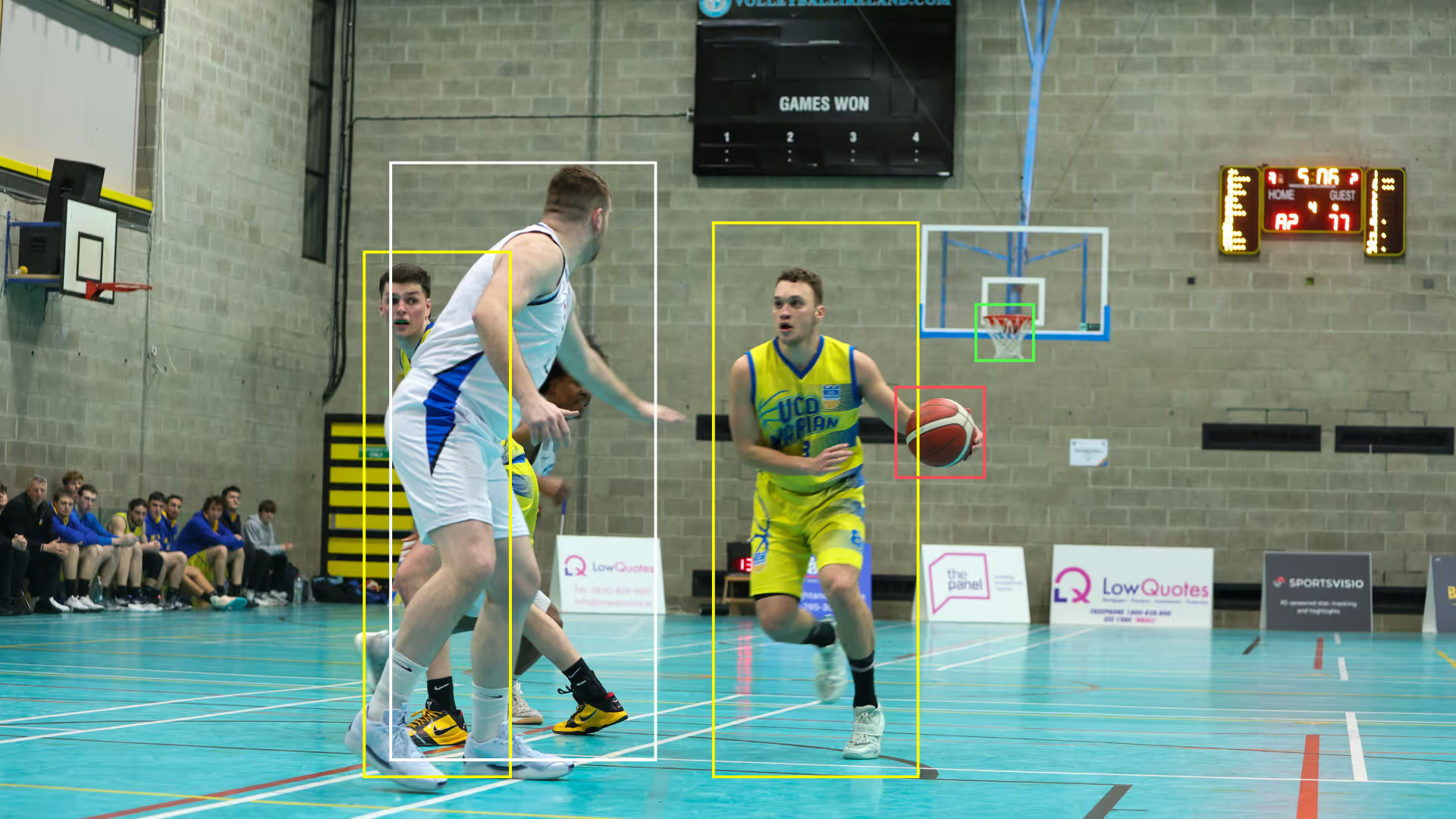
A vision model scans each frame and identifies every player and the ball. This is harder than it sounds. Players occlude each other. The ball is small, fast, and frequently hidden behind a hand or body. The model has to make probabilistic guesses on partial information. The player with the ball doesn't always have the ball in their hand.
Step 4: Tracking and Identity Continuity
A detection model alone treats every frame as new. A tracking layer connects detections across frames so player #23 in frame 1 is still player #23 in frame 1,000, even after a screen, a collision, or going out of frame. This is where most basketball-AI systems break down. Our identity continuity uses jersey numbers, team color, height, and motion patterns to recover IDs after every disruption.
Step 5: Possession and Event Segmentation
With players and ball tracked, the system divides the game into possessions and then into events within each possession: dribble, pass, shot attempt, made shot, rebound, foul, turnover. Each event gets a timestamp and a list of involved players.
Step 6: Stat Attribution and Rule-Based Validation
Detected events get cross-checked against the rules of basketball before they're written into the box score. The model can detect a made shot, but a separate validator confirms it was a legal shot, not a free throw or an out-of-play attempt, and assigns the assist only if a pass-to-shot link is confirmed within the rules. This is where "you cannot have an assist without a made field goal" gets enforced programmatically.
Step 7: Automated Highlight Creation
Every detected event has a timestamp. The system uses event severity (made three, dunk, block, game-winner) and player context (top scorer, rivalry, late-game) to select clips and assemble a highlight reel automatically. No editor required.
Step 8: Coach and Player-Friendly Delivery
The outputs land in three places: a coach dashboard with film and advanced stats, a player app with personal highlights and box scores, and an admin view for the league or tournament. The same processing pipeline serves all three.
What Coach Mode Adds on Top
The eight steps above produce a full game record. Coach Mode is the layer on top that turns the record into a decision aid: opposition scouting reports, lineup-vs-lineup performance, individual player development plans, and pre-built film clips organized by tactical concept (offense vs. zone, pick-and-roll defense, transition defense).
Coach Mode is built for coaches who want NBA-style game prep without an NBA-sized analytics staff.
How We Measure Accuracy
Four kinds of accuracy matter, and any system that doesn't distinguish them is lying to you.
1. Event detection accuracy. Did the system correctly identify that a shot, rebound, or foul happened? For made and missed shots, our system runs at 95%+ accuracy across consumer-phone recordings of amateur, club, and adult-league games. Rebounds and steals are harder (more occlusion, more contested timing) and run at 90%+.
2. Attribution accuracy. Did the system correctly assign the event to the right player? Attribution depends on identity continuity (Step 4 above) holding through the action. Across our processed games, attribution accuracy runs above 92% even when jersey numbers are partially obscured.
3. Timing accuracy. Is the event timestamp aligned with when it actually happened? Sub-second timing accuracy is required for highlight creation and possession segmentation. We hit this consistently because the calibration in Step 2 anchors every event to a known frame rate.
4. Aggregate vs. play-by-play accuracy. Are the final box-score numbers right even if individual events were misclassified? Aggregate accuracy is usually higher than play-by-play accuracy because errors cancel out. A box score showing 22 points might be the result of 22 perfectly attributed scores or 21 correct attributions plus one rebound mistaken for a putback. Aggregate metrics like points per game and shooting percentage are the right place to start trusting AI stats. If you're auditing individual possessions, demand play-by-play accuracy.
Why This Wasn't Possible Five Years Ago
Three things changed that made automated basketball stat tracking practical in 2026:
- Computer vision got cheap. Running the full eight-step pipeline on a 40-minute game used to require server-grade GPUs and hours of processing. It now runs on a single modern GPU in under the duration of the game itself, or on a phone for shorter clips.
- Detection models got accurate enough. Player and ball detection accuracy crossed 95% on consumer hardware around 2023. That's the floor you need before the rest of the pipeline becomes worth running.
- Calibration got automatic. Court-line detection used to require manual setup per camera. Modern segmentation models calibrate any new game in seconds, which is what lets the system work on footage from any phone, any angle, any gym.
The combination is what makes the modern SportsVisio pipeline different from a stat-tracking app five years ago. Each piece existed in some form, but cost or accuracy made them unusable. All three crossed the threshold roughly in parallel.
Capture Recommendations
For the best results from AI basketball analysis, the camera setup matters less than people think, but a few things help:
- Mount the camera on a tripod for stability
- Position to see the full court, including both rims and the key
- Record at 1080p or higher
- Ensure adequate gym lighting and clear jersey contrast
- Avoid obstructions in front of the camera
- Start recording before tipoff and stop after the final buzzer
The system handles most variation in camera position and lighting. The setup recommendations above improve accuracy at the margins.
Frequently Asked Questions About AI Basketball Analysis
How does AI basketball analysis work?
AI basketball analysis uses computer vision to process recorded game video and automatically generate stats, shot charts, and highlights. The system runs a stack of specialized models that handle court calibration, player and ball detection, identity tracking, possession segmentation, event classification, stat attribution, and highlight assembly. SportsVisio's pipeline performs all eight steps without manual tagging.
How accurate is AI basketball stat tracking?
AI basketball stat tracking accuracy depends on the type of stat. Event detection (made shots, rebounds, fouls) runs at 95%+ accuracy on consumer-recorded game video. Attribution to the correct player runs at 92%+. Aggregate box-score metrics like points per game are typically more accurate than individual possession-level events because errors tend to cancel out across a full game.
Can AI generate basketball highlights automatically?
Yes. AI can generate basketball highlights automatically by detecting key events (made baskets, dunks, blocks, three-pointers), assigning each event a significance score based on context, and assembling the top clips into a highlight reel. SportsVisio generates personal highlight reels for every player and team-level highlights for every game without manual editing.
What kind of camera do I need for AI basketball analysis?
Any modern smartphone or tablet camera will work for AI basketball analysis. SportsVisio's system is calibrated to handle a wide range of camera positions, lighting conditions, and resolutions. For best results, the camera should be stable (tripod-mounted), positioned to see the full court, and recording at 1080p or higher.
How long does it take for AI to process a basketball game?
SportsVisio processes a full basketball game and delivers stats, shot charts, and highlights within 24 hours of upload. Most processing happens overnight after the game ends. For tournaments with multiple games, the platform processes them in parallel.
Can AI replace a manual basketball scorekeeper?
For leagues, clubs, and tournaments outside professional basketball, AI stat tracking can replace a manual scorekeeper for the majority of stat-keeping work. AI handles the box score, shot charts, and highlights automatically. Manual oversight is still useful for edge cases like overturned calls and end-of-game clock disputes. NBA-grade tracking still pairs AI with human verification for the official record.
Does AI basketball analysis work for youth or high school games?
Yes. AI basketball analysis works for youth, high school, club, college, and adult-league games. The system was designed for consumer-recorded footage from a wide range of gyms and lighting conditions. SportsVisio is used by hundreds of leagues at every level, from youth recreational play through pro-am tournaments.
What is the difference between AI stats and manually tracked stats?
Manually tracked stats are recorded by a human scorekeeper watching the game. AI stats are generated automatically from video by computer vision and machine learning models. AI stats cover more categories (shot location, possession data, advanced metrics) without the labor cost. Manual stats can be more accurate on edge cases like overturned calls. Most modern leagues now use AI as the primary stat source with manual review for disputes.
The technology is the boring part. What it gives back is what matters.
Coaches get film and advanced stats without an analytics staff. Players get personal highlight reels they actually share. Leagues get NBA-style data accessible from any phone.
Record the game. SportsVisio does the rest.
Related Stories
Book a Demo and Get a Free Trial
Set up time to speak with our team and see our product in action.