
.svg)
.webp)
Dress for the Job You Want: Have Undershirts Become a NCAA Norm?
College basketball looks a lot different now than it did 10 years ago
The pace is faster. Players are stronger, longer, and more position-less. Shot selection is shaped by analytics, and exposure begins long before players ever arrive on campus. What often goes unnoticed are the smaller visual shifts that reflect those larger changes. One of them lives beneath the jersey. In the early 2000s, undershirts were occasionally worn for warmth or injury.
In high school, uniforms are simple and personal
College basketball asks for something different. Details start to matter. Over time, players begin to look less like individuals sharing a court and more like parts of a system. Presentation begins to carry meaning, and one of the earliest signals of that shift is the quiet adoption of the undershirt.
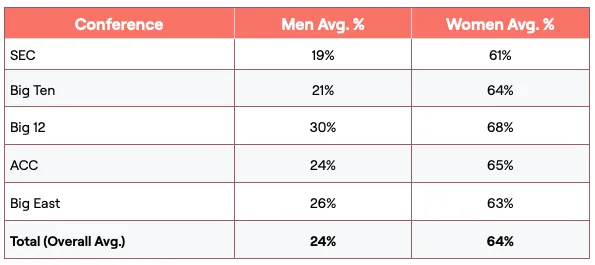
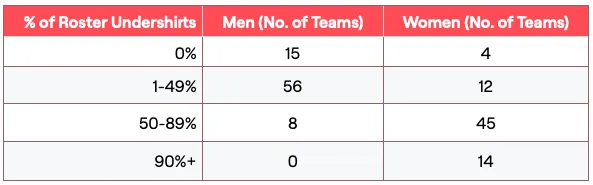
The data suggests that adoption is far from random. Across college basketball, roughly 24% of men’s players wear undershirts compared to 64% of women’s players (Power Five). But averages only tell part of the story. On the men’s side, undershirt usage is scattered: 15 men’s teams have zero players wearing undershirts, and no men’s team reaches even 90% roster adoption. In contrast, women’s basketball shows clear clustering. Fourteen women’s teams have 90% or more of their roster wearing undershirts, and nearly 80% of women’s teams have at least half their players wearing one.
Conference trends reinforce the divide
On the men’s side, usage remains low across the board, topping out in the Big 12 at just over 30% per roster. The SEC and Big Ten each feature multiple teams with no undershirts at all. Women’s basketball tells a different story. Every conference averages above 60%, with the Big 12 and Big Ten leading the way and multiple teams approaching full uniformity.
For Sydney Richards, that uniformity was evident immediately. “Undershirts, honestly, in college it was kind of like the first thing you got,” she said, describing how quickly the habit appeared once she arrived at Cal Poly “In summer workouts, a lot of people would wear that.”
On women’s teams, the choice not to wear one could stand out. “If you didn't wear one, then everybody would be like ‘what the hell, why you have your arms out’.” That reaction helps explain why women’s undershirt usage clusters so high. Consistency becomes part of the visual identity. In practice, undershirts can be utilised to differentiate teams, so because of that, “Everybody has to wear the same undershirt.” So the usage is standard, establishing this conformity early on.
Men’s basketball operates differently
Undershirts are common, but rarely uniform. Austin Rotroff experienced that split firsthand at Duquesne. “Out of my 50-something teammates, I had at least 45 of them wear an undershirt on a regular basis,” he said. Even so, he emphasised that it was rarely debated. “The decision to wear one or not is not really a huge topic of discussion for us; it's just kind of personal preference.”
Comfort often drives that preference
“Some of the jerseys that we wore… were a little bit rougher and heavier,” which made undershirts practical rather than symbolic. Richards pointed to another factor that crosses every side of the game: sweat. “A lot of people played in long sleeve compressions because they sweated a lot.” In that sense, undershirts are less about style and more about endurance- small adaptations to a season that demands constant output.
Still, undershirts didn’t erase individuality entirely. Richards chose short sleeves after getting a tattoo her freshman year, while teammates rolled up jerseys or cuffs to show theirs. Those small decisions highlight what the data suggests: undershirts aren’t a mandate, but they are part of a shared visual language- one learned quickly, especially in women’s basketball.
That language feels far more specific to the American college system
After both players moved on to professional basketball, the difference was immediate. “The jerseys were softer and probably more comfortable,” and Rotroff no longer wears an undershirt. Richards still does.
Which brings the conversation back to aesthetics. In college sports, looking the part matters. On the men’s side, undershirts function largely as a choice- common, practical, but optional. On the women’s side, they operate closer to expectation, shaped by teammates, program culture, and visual consistency. Neither is written into a rulebook. Both are learned. And in a sport increasingly defined by how it looks as much as how it plays, undershirts have quietly become one of the ways college basketball teaches players what professionalism is supposed to look like.
Related Stories
.png)


Book a Demo and Get a Free Trial
Set up time to speak with our team and see our product in action.