
.svg)
.png)
Shot Chart How To and The 5 Shot Signatures Every Basketball Team Falls Into
The 5 Shot Signatures Every Basketball Team Falls Into
Watch enough film and you stop seeing plays. You start seeing patterns.
Great scouts have always been able to describe opposing offenses in a single sentence. "They live in the paint." "They shoot you out of the gym." "They're balanced and boring and they're going to beat you."
Shot charts formalize what your eyes already see.
We just pulled 59,227 shots across a full season of senior league basketball (men and women) and the pattern is consistent with everything NBA analysts have been publishing for years:
Every basketball team, pro, college, amateur, rec, falls into one of five shot signatures. You can identify yours in 30 seconds.
Here they are.
The 5 Basketball Shot Signatures
1. The Paint Bully
- What it looks like: 40%+ of shots inside 10 feet. Sparse mid-range. Moderate three-point volume.
- How they win: Physicality, offensive rebounds, post feeds, transition rim runs. Field goal percentage carries the day.
- How they lose: When you pack the paint and force them to beat you from three, they can't.
- NBA analog: Memphis Grizzlies. Peak Cleveland with Mobley and Allen.
- Real example from our data: One senior team took 45% of all shots within 10 feet and finished 58% of them. That's a team built to impose, not outscore.
2. The Sniper
- What it looks like: 40%+ of shots from three. Minimal mid-range. Moderate paint presence off drive-and-kicks.
- How they win: When the shots fall, nobody keeps up. They win by a lot.
- How they lose: They lose by a lot. Variance is the game.
- NBA analog: 2024–25 Houston Rockets. 2019–20 Dallas Mavericks.
- Real example from our data: One team we mapped took 1,034 threes in a single season, 45% of their total shots. The most three-heavy offense in our sample. They made 33.6% of them, which is the trade: high volume, acceptable efficiency, extreme variance.
3. The Balanced Killer
- What it looks like: Roughly even split across paint, mid-range, and three. No obvious hole.
- How they win: They're the hardest team to scheme against because there's no weakness to sell out on.
- How they lose: Rarely. Usually to a hot Sniper team or an exceptional defense.
- NBA analog: Boston Celtics. Denver Nuggets.
- Real example from our data: One senior team shot 44.3% overall, the most efficient in its league, and did it with balanced volume across the floor. When you're good from everywhere, defenses run out of answers.
4. The Volume Shooter
- What it looks like: High total attempts. Pace-driven offense. Average efficiency.
- How they win: Tempo and attrition. They shoot you into submission.
- How they lose: Against half-court teams that slow the game down.
- NBA analog: Golden State Warriors (2022–24 era). Indiana Pacers.
- Real example from our data: One women's team put up 847 three-point attempts, more than any other team in their league. They're committing to volume at scale. When they're on, nobody outruns them.
5. The Grinder
- What it looks like: Low-to-medium volume, rim-heavy, low three-point rate. High efficiency in the zones they pick.
- How they win: Defense. Half-court execution. Ugly games.
- How they lose: When forced to play faster than they want to.
- NBA analog: 2024 Nuggets. Any Tom Thibodeau team.
- Real example from our data: One senior side shot 43% from within 10 feet on 46% of their total attempts, the most rim-reliant team in their division. They chose one battle and won it.
Three Universal Truths the Data Confirms
Across 59,227 shots, three things held true everywhere: amateur, college, and pro.
1. The mid-range is dead.
Less than 18% of all shots in our sample came from the 10–22 foot range. This is the same trend the NBA has been living for a decade, and it's now bled into every level of the game. If your shot chart shows a big mid-range heat zone, you're either a 2012 throwback or you're playing the wrong shot.
2. The arc is still the biggest bet in basketball.
37% of all shots now come from three. Efficiency (28.7% in our sample) tells you it's still a hard shot. Volume tells you everyone's committed anyway. The math works: 3 × 0.287 = 0.861 points per shot from three, versus 2 × 0.40 = 0.80 from two. Over the course of a game, that fractional edge compounds.
3. Paint volume beats paint efficiency.
The best teams in our sample didn't necessarily finish better at the rim. They got there more often. More paint touches mean more fouls, more offensive boards, more kick-outs. The battle is real estate, not conversion.
How to Read Your Own Shot Chart in 60 Seconds
Print this and tape it to your clipboard.
- Find your archetype. Look at where the majority of your shots come from. Paint? Arc? Everywhere? Now you know what kind of team you are.
- Find your green zones. Where are you above league-average efficiency? Take more shots from there.
- Find your red zones. Where are you below league-average efficiency? Take fewer shots from there, or put in work (but honestly, take fewer).
- Find your contradictions. A high-volume cold zone is the single most important thing to fix. Most teams have at least one.
- Compare game to game. A shot chart from one game is noise. The pattern across ten games is the signal.
Most coaches know where their offense wants to score. The shot chart tells you where it actually scores. Those are often different maps.
"The Nitty-Gritties and the Details"
Jaja Davis plays semi-pro basketball. He's a detail guy.
"I like when I can look up a game that I've had and I really want to study what I did wrong or where I can be more effective. SportsVisio gets down to the nitty-gritties and the details."
That's the loop every great player runs: pro, college, youth. Play the game. Read your film and your chart. Fix one thing next week.
Watch Jaja's full testimonial →
Coach Mode v2: Everything Above, Automatic
Shot signatures. Zone efficiency. Per-player heat maps. Archetype classification.
We're putting all of it (every chart, every shot, every player) in every coach's pocket this summer.
Coach Mode v2. Coming this summer.
Frequently Asked Questions
What are the 5 basketball shot signatures?
Every basketball team, at every level, falls into one of five shot signatures based on where and how they take shots:
- The Paint Bully — 40%+ of shots inside 10 feet. Wins with physicality and rim pressure.
- The Sniper — 40%+ of shots from three. Wins on volume; loses to variance.
- The Balanced Killer — Even split across paint, mid-range, and three. No weakness to exploit.
- The Volume Shooter — High pace and attempts. Wins on tempo.
- The Grinder — Rim-heavy, low three-point rate. Wins ugly with defense and execution.
Archetypes were identified from 59,227 shots across four senior basketball leagues.
What does a basketball shot chart show?
A basketball shot chart maps every shot a team or player takes on the floor, showing where shots were attempted, whether they were made or missed, and efficiency (field goal percentage) by zone. Modern shot charts typically break the court into zones (restricted area, paint, mid-range, three-point arc, corner threes) and display volume and accuracy in each. Coaches use them to identify strengths, weaknesses, and shot selection patterns.
Is the mid-range really dead in modern basketball?
Largely, yes. In our sample of 59,227 shots across senior basketball, less than 18% of shots came from the 10–22 foot mid-range. The shift started in the NBA over a decade ago, driven by efficiency math (threes are worth more, rim shots convert at higher percentages), and has now reached every level of the game, including youth, high school, college, and amateur leagues.
How can coaches use shot charts to improve their team?
Coaches should use shot charts in four steps. First, identify the team's archetype (Paint Bully, Sniper, Balanced Killer, Volume Shooter, or Grinder) to understand what kind of team they are. Second, find "green zones" where the team shoots above league-average efficiency and run more plays from there. Third, identify "red zones" where the team shoots below average and take fewer of those shots. Fourth, spot "contradictions" (high-volume zones with low efficiency), which are the single biggest fixes available. Track charts across 10 or more games, not single games, to separate signal from noise.
How does SportsVisio generate shot charts automatically?
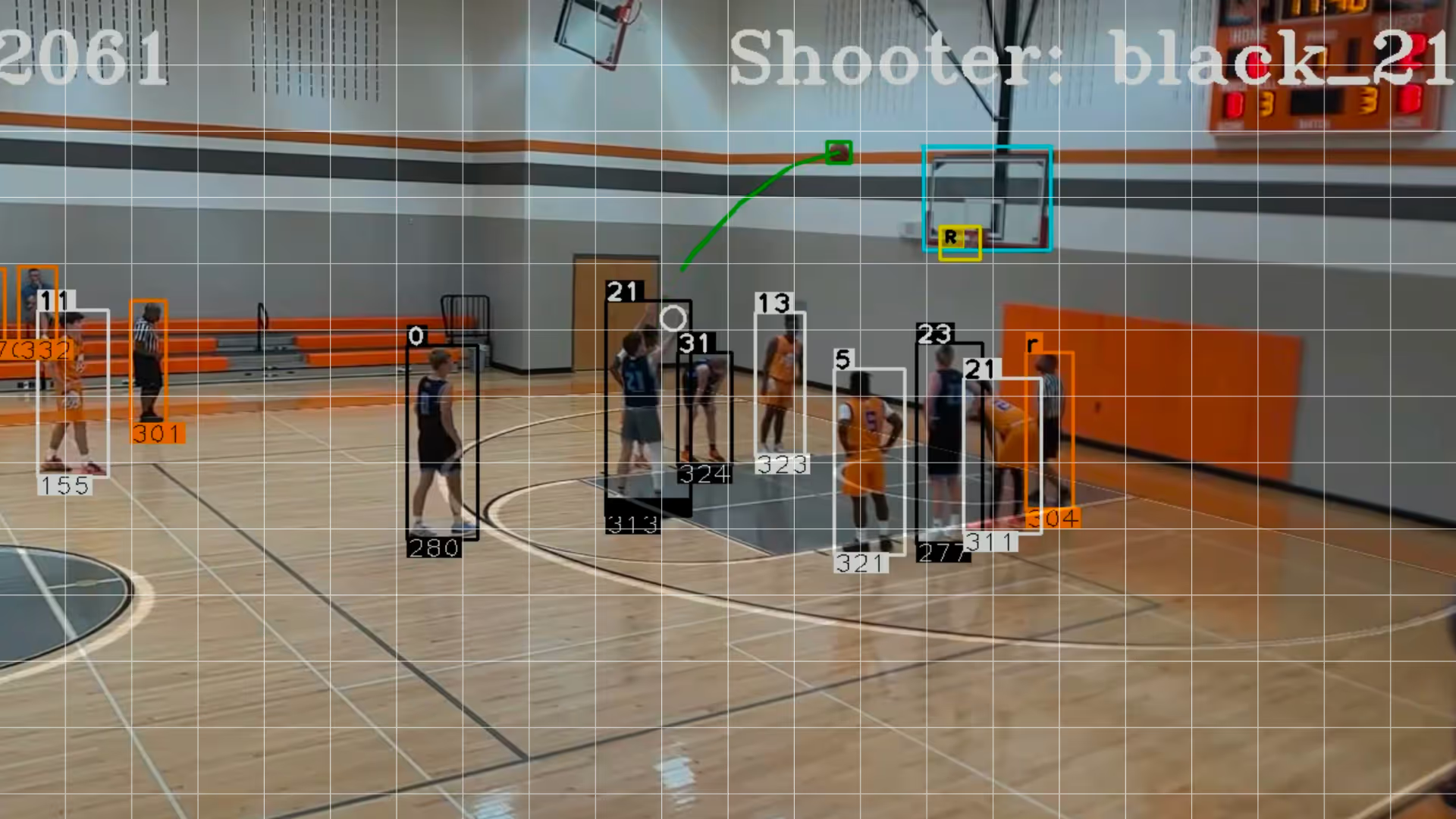
SportsVisio uses AI and computer vision to process standard game footage from any camera. The system identifies every shot, classifies made and missed attempts, maps shot location on the floor, and attributes shots to individual players. No stat crew, manual entry, or special hardware is required. Coaches get a full shot chart, box score, and individual player highlights after every game, typically within hours of upload.
Related Stories


Book a Demo and Get a Free Trial
Set up time to speak with our team and see our product in action.